
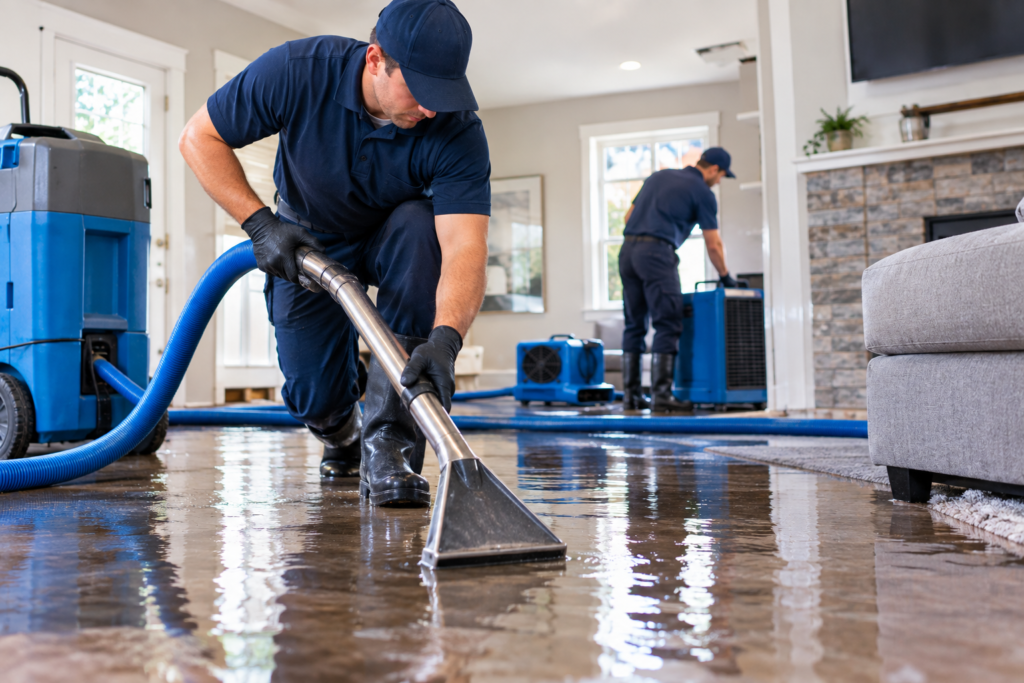
When water floods a home in Little Rock, the first few hours are not just important. They are the window that determines whether the damage stays manageable or compounds into a weeks-long restoration project. Every hour of standing water contact multiplies absorption into flooring, framing, drywall, and insulation. Every hour of delay closes the mold prevention window a little further.
Most homeowners have never been through a serious water emergency and do not know what to expect when a professional crew arrives. Here is an honest account of what happens from the moment the call goes out to the point where extraction is complete and drying is underway.
The Call and the Dispatch
The clock starts when you call. A certified restoration company operating with a genuine 24-hour emergency response capability dispatches a crew immediately, not at the start of business the next morning. The information that matters most in that first call is what the water source is, whether the source is still active, roughly how much area is affected, and whether the property is safe to enter.
If the source is still running, the first instruction from the dispatcher will be to shut off the main water supply if it is a plumbing failure, or to stay out if it is a sewage backup or storm flood. Getting that information to the crew before they arrive means they pull the right equipment load before leaving the facility rather than making a second trip.
Response time in Little Rock for a genuine emergency dispatch from a local restoration company should be under two hours. If a company cannot commit to that window, the job is going elsewhere.
Site Assessment on Arrival
The crew does not start pulling water the moment they walk through the door. The first 15 to 20 minutes on site are a rapid but systematic assessment that determines the entire scope of work.
The lead technician identifies the water category first. Clean water from a burst supply pipe is Category 1. Grey water from an appliance overflow or minor groundwater event is Category 2. Sewage backup, storm flooding, or any water that has contacted contaminated sources is Category 3. The category determines PPE requirements for the crew, what materials can be saved versus must be removed, and whether antimicrobial treatment is part of the immediate scope.
Moisture mapping runs simultaneously with the visual assessment. Technicians use thermal imaging cameras and pin moisture meters to trace where water has traveled beyond what is visible. Water that entered at one point migrates laterally along floor joists, runs down wall cavities, and pools at low points far from the source. In a Little Rock home with a slab foundation, water travels across the slab surface and wicks into every material it contacts along the way. In a pier-and-beam home, it drops into the crawl space and begins saturating the subfloor assembly from below.
A water damage assessment report documents all of this before extraction begins. That documentation is what the insurance adjuster needs to see, and it establishes the pre-remediation condition that protects the claim through the full restoration process.
Extraction: Getting the Water Out
Once the assessment is complete and the crew has the full picture of where the water is and what category it represents, extraction begins. This is the phase most homeowners picture when they think of emergency water removal, and it is where professional equipment makes the biggest difference between a 2-hour job and a 2-day one.
Truck-mounted extraction units pull water at volumes no portable consumer equipment can approach. Submersible pumps handle standing water above a few inches. Weighted extraction tools follow after the bulk water is gone, pulling remaining surface water from carpet, padding, and hard flooring. Emergency water extraction on a flooded first floor in a standard Little Rock home typically takes 1 to 3 hours depending on the water volume and the number of affected rooms.
Carpet and carpet padding decisions happen during this phase. Carpet that absorbed Category 1 water and was extracted within the first few hours has a reasonable salvage window. Carpet that absorbed Category 2 or Category 3 water, or that sat wet for more than 24 hours, comes out. Carpet padding almost never survives a significant water event regardless of category – it retains moisture at its core even when the surface appears dry and creates ongoing conditions for mold growth if left in place.
For properties with crawl spaces, crawlspace water extraction requires separate equipment deployment in the crawl space itself. Water that entered below the floor cannot be addressed by equipment working only at grade level.
Structural Drying Begins Immediately After Extraction
Extraction removes water. It does not remove moisture. The moment bulk water is gone, structural drying equipment goes in – and this happens on the same visit, not a scheduled return the next day.
Commercial dehumidifiers are positioned to pull moisture from the air column as materials release it. The capacity of commercial units measured in pints per day makes a residential dehumidifier from a hardware store essentially irrelevant for comparison. Air movers are placed to maximize evaporation rates across affected floor and wall surfaces. The configuration is specific to the room geometry and the affected material types, not a generic placement.
Structural drying dehumidification in Little Rock operates in Arkansas’s humid subtropical climate, which means the ambient moisture load on the equipment is higher than in drier markets. Equipment sizing accounts for both the moisture in the affected materials and the moisture in the outdoor air that is constantly being exchanged with the indoor environment. Undersized equipment in Arkansas’s climate is one of the most common reasons structural drying projects run longer than they should.
For wall cavities that are confirmed saturated by moisture mapping, drying either happens through targeted air mover placement at wall penetrations, or the drywall comes out. Drywall water damage repair is a downstream scope item, but the decision about whether to open walls happens at this stage based on moisture readings, not assumptions.
Documentation Throughout
Every reading, every equipment placement, every photo taken during the first response visit becomes part of the project file. Daily drying logs record moisture readings at every monitoring point from extraction day through final clearance. This documentation serves two functions: it confirms the drying is progressing and guides equipment adjustments, and it provides the paper trail the insurance company needs for the claim.
Insurance claim assistance through the restoration process means the homeowner is not left navigating the adjuster relationship alone. The documentation the crew generates is formatted to meet what adjusters need to process the claim accurately.
What the First Few Hours Determine
By the time the crew packs up after the initial response visit, the standing water is gone, drying equipment is running, and every affected material has been moisture-mapped and documented. The mold prevention window is still open. The insurance claim has a clean starting point. The scope is defined.
None of that happens if the call gets made six hours later, or if the first response is a handyman with a shop vac. Little Rock’s climate gives water damage events a short window before secondary damage compounds the primary loss. The first few hours are the intervention point that controls everything that follows.
Little Rock AR Water Damage serves Little Rock, North Little Rock, Maumelle, Bryant, Benton, Conway, Jacksonville, Sherwood, and surrounding Pulaski County communities with 24-hour emergency water extraction, structural drying, mold remediation, sewage cleanup, and fire damage restoration. IICRC-certified.
Call us any time at our emergency line or visit our services page for the full scope of what we handle.
Leave a Reply